

Outdoor sweeping is the hardest cleaning job to automate, because the environment is not controlled. Sun, rain, kerbs, parked cars, pedestrians and hours of darkness all arrive without notice, and a machine that needs ideal conditions spends most of the year parked.
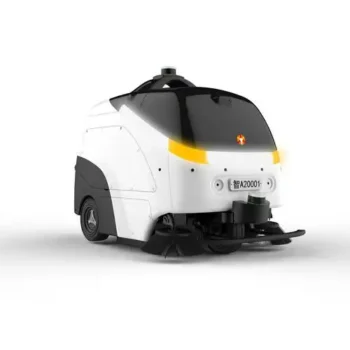
The Bees is a plaza-type unmanned sweeper built for real outdoor conditions. Dual sweeping discs and a roller brush take everything from dust to fallen leaves, spray dust suppression and dry cartridge filtration prevent secondary dust, and laser SLAM combined with RTK holds centimetre-level positioning across a route that spans hundreds of metres.
Where the Bees sits in the range
The Bees is the paved-area outdoor sweeper. Where the surface is rougher and the requirement is road and park sweeping at a smaller scale, the S100-N covers it. Where the work is entirely indoors, the Monster or Beetle is the right platform. Bees is built for plazas, promenades and station forecourts where a crew would otherwise be working in traffic.
What sets the Bees apart
- Dual sweeping discs plus roller brush, taking dust through to fallen leaves in one pass
- Spray dust suppression with dry cartridge filtration, so sweeping does not create a dust plume
- Multi-line LiDAR, ultrasonic radar, high-precision GPS with RTK and GMSL cameras
- Centimetre-level positioning and 100 m detection range across a long outdoor route
- IR camera for night operation, with rain avoidance logic for weather-driven scheduling
- Automatic dumping, charging, water refill and parking, plus one-key recall
- 14 unmanned functions including patrol, edge sweeping, resume after interruption and OTA
- 8.913 kWh LiFePO₄ battery with four hours of continuous operation and 3.2 kW wireless charging
- 30% gradeability, braking distance of 0.5 m or less and a turning radius under 1.2 m
Bees specifications
| Model | YFSLR14 |
|---|---|
| Product type | Plaza-type unmanned sweeping robot |
| Dimensions (L × W × H) | 1945 × 1240 × 1580 mm |
| Kerb weight | 680 kg |
| Maximum permitted gross weight | 810 kg |
| Applications | Plazas · parks · sidewalks · airports · high-speed rail stations |
| Sweeping width | 1.43 m |
| Sweeping speed | 3 – 5 km/h |
| Maximum sweeping capacity | 7,150 m²/h |
| Waste bin | 70 L |
| Clean-water tank | 60 L |
| Continuous operation | 4 hours |
| Working noise | ≤ 65 dB(A) |
| Battery | LiFePO₄ 8.913 kWh / 51.52 V |
| Full charge time | 4 hours |
| Drive motor peak power | 5 kW at 6,000 r/min |
| Maximum travel speed | 10 km/h |
| Gradeability | 30% |
| Braking distance | ≤ 0.5 m |
| Minimum turning radius | ≤ 1.2 m |
| Navigation | Laser SLAM plus RTK, centimetre-level positioning |
| Sensors | Multi-line LiDAR · ultrasonic radar · high-precision GPS · GMSL cameras · IR camera |
| Detection range | LiDAR and cameras 100 m |
| Control algorithm | MPC model-predictive control |
| Workstation | 695 × 750 × 1270 mm including water pipe |
| Wireless charging | 3.2 kW output, charge time under 4 hours |
| Water refill time | 10 minutes or less |
Best suited to
City plazas and pedestrian streets. Parks, promenades and scenic roads. Airport and high-speed rail station forecourts. Industrial park roads and large residential compounds with paved outdoor areas.
Deployment and support
Jaelin Tech supplies the Bees worldwide, with commissioning support, operator training, spare parts and remote technical support. Send us your floor area, surface type and the soiling you are dealing with, and we will confirm whether the Bees is the right machine or point you to a better fit in the range. OEM and ODM cooperation is available.
Frequently asked questions
Can it work in the rain?
It has rain-avoidance logic and returns to the workstation rather than continuing a wet sweep. Rain is treated as a scheduling condition, not something to sweep through.
How does positioning hold over a long outdoor route?
Laser SLAM is fused with RTK, which anchors the map to satellite positioning. That is what keeps accuracy at centimetre level over hundreds of metres, where SLAM alone drifts.
What happens at the workstation?
Dumping, charging, water refill and parking are automatic, and a full charge takes under four hours at 3.2 kW wireless output. A water refill takes ten minutes or less.
Related models
If your requirement leans a different way:


Reviews
There are no reviews yet.