
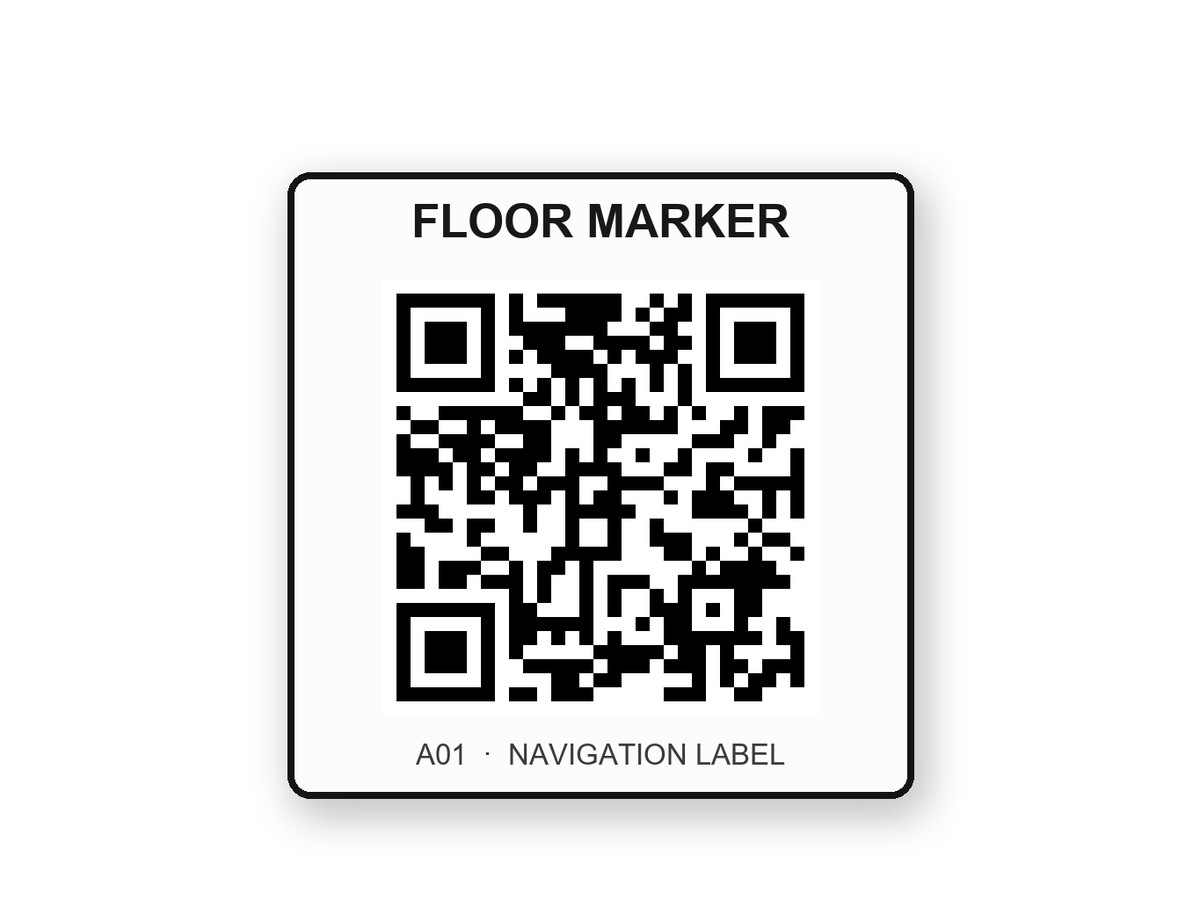
Some robots find their position by reading marks on the floor. If you run that kind of fleet — or you are fitting out a site in advance of one — the floor markers become a consumable: they wear under trolley traffic, they get covered by pallets, and they get lifted whenever a floor is resurfaced. They are cheap, unglamorous, and the reason a robot can stop in exactly the right spot.
What floor markers do
A floor marker gives the robot an absolute reference point: instead of only estimating where it is from movement and sensors, it reads a known mark and corrects its position. That is what allows precise stopping at a charging dock, an exact station along a conveyor, or a defined delivery point in a corridor.
Markers are also what makes a route reproducible after a layout change. Re-lay a few marks and the route is valid again, without re-teaching the whole floor.
Which marker type you need
This is decided by your robot’s navigation method, not by preference. Confirm before ordering:
| Navigation method | Marker type | Typical use |
|---|---|---|
| Fiducial / code-based positioning | Printed code marker, laminated or over-coated | Charging docks, work stations, dense stop points |
| Magnetic guidance | Magnetic guide tape or magnetic marker | Fixed lanes, one-way routes, long straight runs |
| Reflective / laser-based positioning | Reflective floor or wall target | High-bay and wide-open areas |
Choosing a QR code floor marker that survives the floor
- Substrate first: epoxy, sealed concrete and ceramic tile each need a different adhesive system. A marker that lifts in a week is usually a backing problem, not a printing problem.
- Traffic: markers in trolley lanes take far more abuse — specify an over-laminated or coated marker there.
- Cleaning: markers must survive your floor cleaning routine, including machine scrubbing. Solvent-resistant lamination matters on floors cleaned daily.
- Batch coding: markers are usually applied in sets. Order them as a numbered batch so replacement of a damaged marker is a one-minute job.
These markers are used with our AMR range — including the F150, F300 and F600 — and with service robots such as Panda where a fixed stop point is required. Tell us the navigation method and we will confirm the matching marker type.
Ordering and pricing
Floor markers are quoted per order by size, material, quantity and coding. Describe your floor type, how many stop points you are marking, and the robot’s navigation method, and we will quote accordingly. Request a quote, or browse our spare parts and consumables.

Reviews
There are no reviews yet.